Meeseeks vs Minion Agents
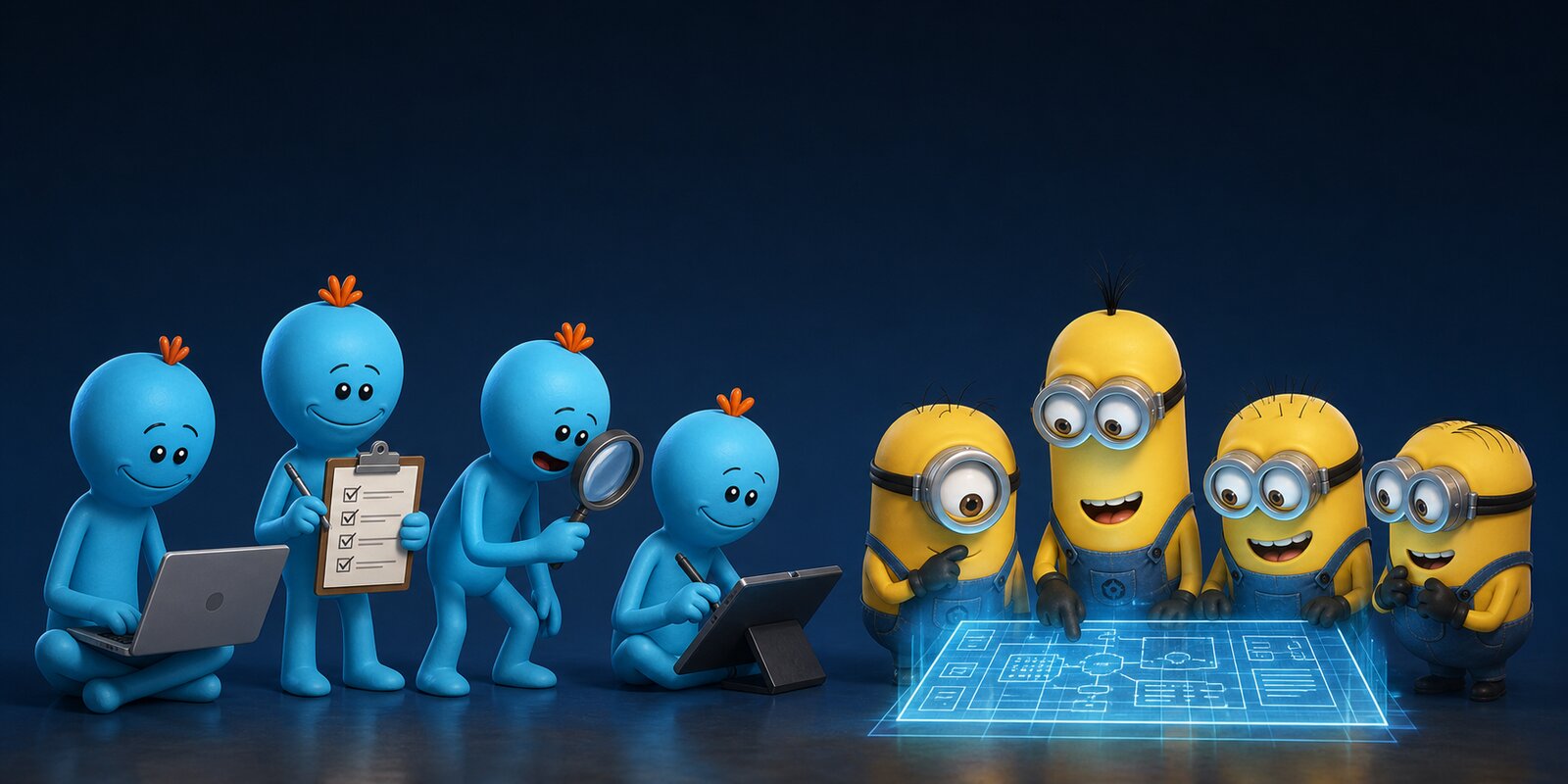
By now we're not only working with agents, but with subagents, i.e. a small team that the main agent spawns that can take different roles like developer, reviewer, designer and so on. Usually, though, Claude will spawn more Claudes, Codex more Codexes, and while their formal roles might differ, the underlying model (weights, training, data) is the same.
Meeseeks has become a popular reference for this kind of subagent, and the analogy makes sense, as they are created to perform one task and disappear when it is done. This makes them useful for parallel work, where one can research a library while another writes tests and a third changes the code.
While Meeseeks-style subagents have their use cases, it is worth noting that they also have some shortcomings when it comes to collaboration and critical review. The value of a reviewer or even a collaboration partner is usually not simple confirmation, but a second point of view or opinion that is founded in their set of experiences and history. Now, if that partner is your clone with the exact same memory and history, how much of a different and critical view can they have? So if you're using the same model with mostly the same context history, how thorough and critical can it be?
There is evidence that models are biased toward their own output. A 2024 paper found that language models tend to rate their own generations more highly than equally good generations from other models. The effect became stronger when a model was better at recognizing its own output. The study was about evaluating text, not reviewing code, so we should not claim more than it proves, but it reveals a problem with the architecture: a second instance of a model is not necessarily a second opinion.
Engineers who build safety-critical systems have dealt with a similar problem for a long time: If three flight computers run the same software, they can survive the failure of one computer. They may not survive a bug in the software, because all three computers will make the same mistake. This is called a common-cause failure.
One way to reduce it is dissimilar redundancy: different implementations perform the same function and check one another. The equivalent for coding agents is to let different models do the writing and the reviewing.
I've started using this regularly, e.g. with multiple Codex coders and a Claude verifier or manager. The verifier would repeatedly find things the coder had considered finished and tested, like bugs, incomplete requirements, missed edge cases, and generally tests that did not prove as much as their names suggested.
I've started referring to this setup as Minion agent teams, leaning into the Meeseeks analogy, but acknowledging that, unlike the former, Minions are not mere clones but have different personalities.
Different models also create new problems, as they cost more, require more integrations, and fail independently. I saw this for example when the Anthropic and Gemini backends started returning errors while OpenAI continued working. So using several models is not automatically better, but useful in specific places, like verification or when you need more "thought" and solution diversity. For simple decomposition and parallel work, same-model agents should usually still be fine and the easier choice.
So when designing agent systems in the future, think if you need blunt parallelization or critical diversity, think if you need Meeseeks or Minions to solve the task.